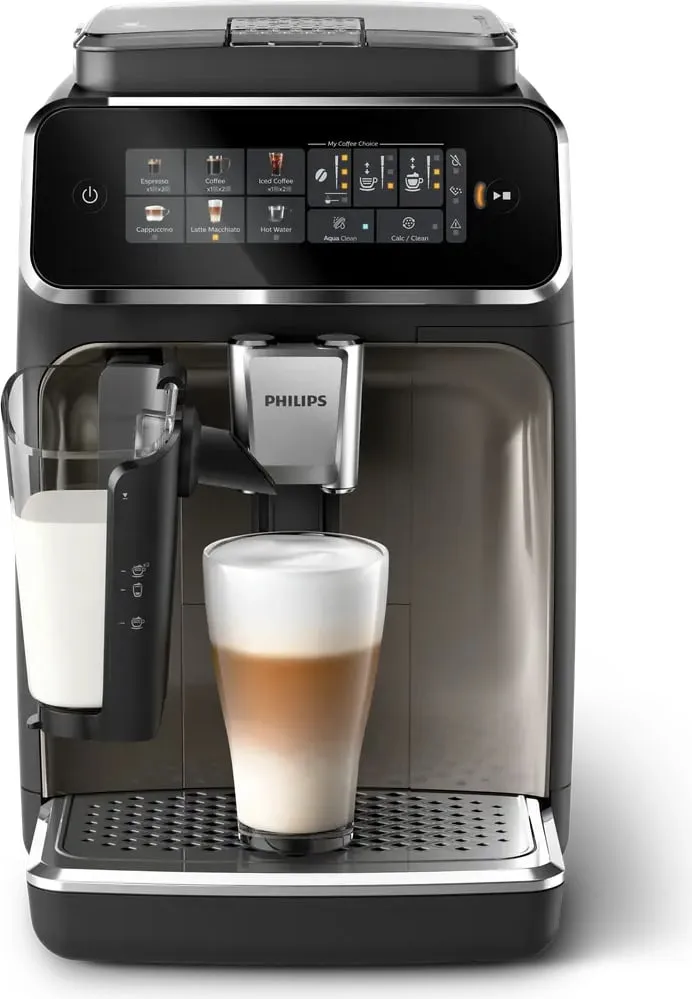
- Milk system
- LatteGo
- Water tank
- 1.8 l
- Drinks advertised by the manufacturer
- 5
- Width
- 24.6 cm
Price at Amazon:£420.86Including VAT; delivery may be extra. The price is checked once a day and may have changed since. The price shown on Amazon at the time of purchase is the one that applies.
Regular price on the manufacturer’s website:£569.99
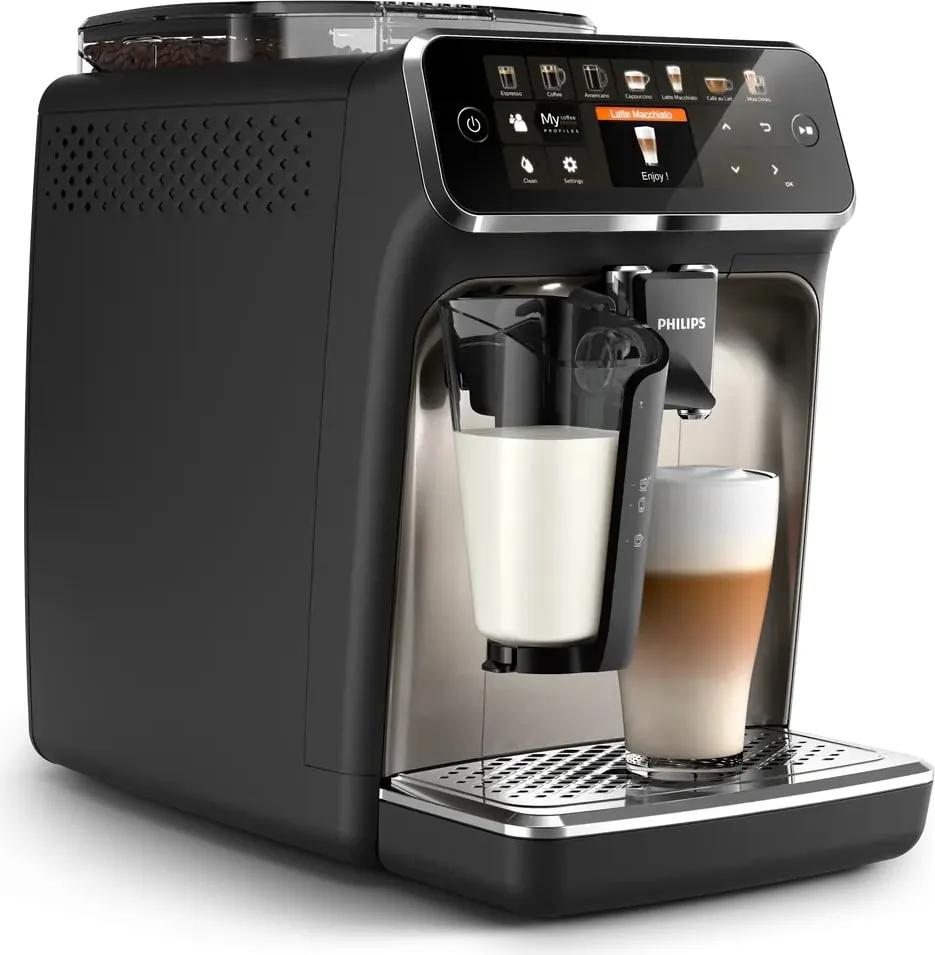
- Milk system
- LatteGo
- Water tank
- 1.8 l
- Drinks advertised by the manufacturer
- 12
- Width
- 24.6 cm
Spec sheet against spec sheet
| Feature | | |
|---|---|---|
| Pump pressure | 15 bar | 15 bar |
| Power | 1,500 W | 1,500 W |
| Water tank | 1.8 l | 1.8 l |
| Bean hopper | 275 g | 275 g |
| Grind settings | 12 | 12 |
| Milk system | LatteGo | LatteGo |
| Drinks advertised by the manufacturer (Difference) | 5 | 12 |
| Controls (Difference) | Touch panel | TFT display |
| Weight | 8 kg | 8 kg |
| Removable brew group | Yes | Yes |
| Manufacturer warranty | 2 years | 2 years |
| App connectivity | No | No |
| Grinder material | Ceramic | Ceramic |
| Milk container | 0.26 l | 0.26 l |
| User profiles (Difference) | not stated | 4 |
| Dimensions (W × H × D) | 24.6 × 37.1 × 43.3 cm | 24.6 × 37.1 × 43.3 cm |
| Price bracket (Difference) | Mid-range | Upper mid-range |
| Price at Amazon (Difference) | £420.86 | not stated |
| Manufacturer’s price (Difference) | £569.99 | not stated |
| Offer | Check price on Amazon | Check price on Amazon |
Difference. Sources: manufacturer spec sheets and product pages. “not stated” means not stated by the manufacturer or not yet verified by us. Prices at Amazon: as of 10 Nov 2026, 10:31, checked once a day. They may have changed since; the price shown on Amazon at the time of purchase applies. As an Amazon Associate I earn from qualifying purchases.
Identical hardware, different interface
Put the two spec sheets side by side and most lines are identical. That is the main finding. Philips builds the 3300 and the 5400 on the same body, and the data it publishes for the coffee side does not differ: 15 bar, the same power, a 1.8 l tank, a 275 g hopper, 12 grind settings on a ceramic grinder, and the same 0.26 l LatteGo container.
The step up therefore buys interface, not capacity:
- A couple with settled habits gets everything on the 3300. Five programmed drinks cover the daily cappuccino and latte macchiato.
- A household of three or four with different tastes is who the 5400 is for. Profiles mean nobody has to re-enter their strength and volume.
- Someone who wants iced coffee should note that it is the 3300 that has the recipe.
What the 5400 adds
User profiles. Philips states 4 on the 5400, plus a guest profile. The 3300 has none in the Philips data we read; the table reads not stated for it because we only enter a figure where Philips gives one. If you are the only one who drinks milk coffee at home, a profile is a feature you will not notice. With four people it is the reason to pay more.
Drinks. 12 programmed drinks against 5, in Philips’s spec data. The 3300’s five are espresso, coffee, cappuccino, latte macchiato and iced coffee; Philips’s product name says six by adding hot water. Before you pay for the longer list, ask how many of twelve you would press in a normal week.
Display. The 5400 has a TFT display. The 3300 has a touch-sensitive panel, a row of keys and not a graphical screen. A display matters more when there are twelve drinks and four profiles to move between.
Price bracket. The 3300 sits at the top edge of our mid-range bracket and the 5400 in the upper mid-range. Where available, this page shows the Amazon price, with the date and time we checked it; it is checked once a day and may have changed since, so the price that counts is the one Amazon shows when you buy. The manufacturer’s RRP is given too where the manufacturer publishes one. The cost per cup calculator will spread the difference over the cups you expect to make.
What does not change
It is worth spelling out what stays the same, because it is easy to assume that a dearer machine holds more.
- Milk. The LatteGo container is the same size on both. At an assumed 100 to 120 ml of milk per cappuccino, a fill covers about two drinks on either machine. A family of four will top up half-way on the 5400 just as on the 3300. If that sounds tiresome, a hose-fed machine such as the Siemens EQ.6 plus s300 draws straight from the carton.
- Water and beans. Same tank, same hopper. A bigger household refills both more often; the 5400 does not help there.
- Footprint. Same width, depth and weight. The display costs no worktop.
- Connectivity. Philips answers “no” for both.
- Brew group. Removable on both. For the 3300, the manual for the 2300 and 3300 series tells owners to take it out every week and rinse it (Philips user manual, 2300 and 3300 series); our cleaning guide explains why people care.
UK model codes
The 3300 data was read on the EP3347/90, which Philips lists in the UK. The 5400 data was read on the EP5447/90 sold in Germany and France; the UK model is the EP5446/70, with the same capacities in what we read and a height given one millimetre greater. Both series also include models this page does not cover, notably 3300 machines with a manual frother (EP3324/40, EP3326/90). Check the model code and the word LatteGo on the listing. Philips’s UK product data gives a two-year warranty for both.
Beyond the spec sheets
- The cup. With identical published coffee hardware the data gives no reason to expect a difference, but only measurement can show it, and we have not yet measured either machine.
- Noise. Philips names SilentBrew on both spec sheets and gives no decibel figure for either. We make no claim; noise is on our list of planned measurements.
- How the interfaces feel. Whether a display is quicker than a panel for your household is not in a spec sheet.
- Milk foam. Same system by name; no data on the result.
This comparison rests on manufacturer data only. Our own measurements will follow as we buy machines, and will be labelled as such.
Where to go next
The individual profiles give the source for every figure: Philips 3300 LatteGo and Philips 5400 LatteGo. The 2200 and 5500 complete the picture in our Philips range comparison, and rival milk systems are in bean-to-cup machines with a milk system. Unsure where to start? The machine finder works from your drinks, your space and your price bracket.
Which one suits you?
A
Philips Series 3300 LatteGo EP3347/90
Choose this model if…
- one or two people use the machine and drink much the same thing,
- espresso, coffee, cappuccino and latte macchiato cover what you drink,
- you want an iced coffee recipe,
- you would rather stay in the lower price bracket.
B
Philips 5400 Series LatteGo EP5446/70
Choose this model if…
- three or four people each want their own strength and volume remembered: Philips states 4 user profiles plus a guest profile,
- you want 12 programmed drinks rather than 5,
- you prefer a TFT display with drink names to a touch-sensitive panel.
Frequently asked questions
Is the Philips 5400 LatteGo bigger than the 3300?
No. Philips gives the same body for both: 24.6 cm wide, 43.3 cm deep and about 37 cm high, at 8 kg. The tank (1.8 litres), bean hopper (275 g) and LatteGo container (0.26 litres) are identical too.
Does the 5400 make better coffee than the 3300?
Nothing in the data suggests a difference in the coffee hardware: same pump pressure, power, grinder material and 12 grind settings. Whether the cup differs is a question for measurement, and we have not yet measured either.
Which one has user profiles?
The 5400: Philips states 4 user profiles plus a guest profile. The 3300 has none.
Can the 5400 make iced coffee?
Iced recipes are a feature Philips gives to the 3300 and the 5500, not the 5400. If iced drinks matter and you want the display and profiles as well, look at the 5500 LatteGo.
Is the milk system the same on both?
Yes. Both use the LatteGo carafe, which Philips describes as two parts with no tubes, with a 0.26-litre container.