The short answer
A bean-to-cup machine needs four kinds of attention, and they should not be confused:
- Rinsing what touches milk, after every use.
- Emptying the drip tray and the grounds container, when the machine asks or sooner.
- Cleaning the brew unit, weekly or monthly depending on the maker.
- Descaling, when the machine asks. That one has its own guide.
Whether tablets come into it depends on the brand. Philips and De’Longhi, the two ranges that fill most of our bean-to-cup tables, take opposite approaches, as their manuals show. We have not cleaned these machines ourselves: every instruction below is taken from the manufacturers’ documents, read on 10 November 2026.
The schedule, side by side
Philips publishes one routine for its whole bean-to-cup range (How to clean and maintain my Philips Espresso Machine). For De’Longhi we read the manuals of the Magnifica S (ECAM11.1XX - 12.1XX - 20.1XX - 21.1XX - 22.1XX Bean to cup espresso and cappuccino machine, Instructions for Use) and the Magnifica Evo (ECAM29X.6Y - 29X.8Y EX:1 Bean to cup espresso and cappuccino machine, Instructions for Use).
| Part | Philips | De’Longhi Magnifica S and Evo |
|---|---|---|
| Drip tray | Empty daily, or as soon as the red indicator pops up | Empty and clean before the red level indicator rises above the cup tray |
| Grounds container | Empty when prompted; clean weekly | Empty and clean when the light comes on. The Evo also asks 72 hours after the first coffee, even if the container is not full |
| Water tank | Rinse weekly under the tap | Clean about once a month, and whenever the filter is changed |
| Brew unit | Rinse weekly with lukewarm water; coffee oil remover tablet monthly; grease every two months | Clean at least once a month, with water only |
| Inside of the machine | Not covered in the article | Check about once a month, with the machine switched off and unplugged |
| Coffee spouts | Not covered in the article | Clean about once a month |
| Milk parts | After each use (see below) | After each use (see below) |
Two details from the De’Longhi manuals are easy to miss. First, when you take out the drip tray, the grounds container must be emptied too, even if it is nearly empty, otherwise it can overfill later and clog the machine. Second, the Evo’s 72-hour count only works if the machine stays plugged in.
Cleaning tablets: who asks for them and who does not
This is where the two brands part company.
Philips builds tablets into the routine: once a month, a coffee oil remover tablet is used to clear oil from the filter of the brew group. Philips sells a separate cleaner for the milk circuit, also monthly on machines with a classic milk frother or a carafe, and a descaler for scale. That makes three products with three jobs.
De’Longhi states the opposite in both manuals: with its bean-to-cup machines, no chemical products are required for cleaning. For the brewing unit the Evo manual is emphatic: water only, no detergents, no dishwasher. The Magnifica S manual says washing-up liquid could damage it, and to soak the unit in water for about five minutes before rinsing it under the tap. The same manual rules out solvents, abrasive detergents and alcohol for the machine as a whole, and says none of its components can be washed in a dishwasher. De’Longhi’s product pages are looser on that last point and do not agree with each other (the UK page mentions the drip tray grid, the German page the grounds container), so follow the manual.
The practical consequence: a multipack of universal cleaning tablets is not a safe default purchase. On a Philips, the manual tells you which tablet to use and when. On a De’Longhi Magnifica, the manuals we read give you no programme to use it in.
Removable brew unit: what our data says
A removable brew unit is the reason both routines above are possible at all: you take the mechanism out and rinse it. The table shows what each maker states for the bean-to-cup machines sold in the UK that we list, along with the type of milk system, since that is the other part of the daily routine.
Table scrolls sideways →
| Model | Offer | |||||
|---|---|---|---|---|---|---|
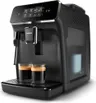 Philips Series 2200 EP2220/10 | Yes | Steam wand | not stated | not stated | £329.99 (RRP) | Check price on Amazon |
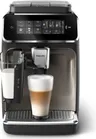 Philips Series 3300 LatteGo EP3347/90 | Yes | LatteGo | 0.26 l | £420.86 | £569.99 | Check price on Amazon |
 Philips 5400 Series LatteGo EP5446/70 | Yes | LatteGo | 0.26 l | not stated | not stated | Check price on Amazon |
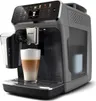 Philips 5500 Series LatteGo EP5546/70 | Yes | LatteGo | 0.26 l | £518.36 | £669.99 | Check price on Amazon |
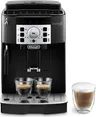 De'Longhi Magnifica S ECAM 22.110.B | Yes | Steam wand | not stated | £299.99 | £349.99 | Check price on Amazon |
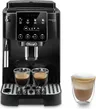 De'Longhi Magnifica Start ECAM 222.20.B | Yes | Steam wand | not stated | £364.49 | £319.99 | Check price on Amazon |
 De'Longhi Magnifica Evo ECAM 290.83.TB | Yes | Milk carafe | not stated | not stated | £579.99 | Check price on Amazon |
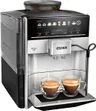 Siemens EQ6 plus s300 TE653M11GB | Yes | Milk hose | not stated | not stated | not stated | Check price on Amazon |
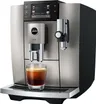 JURA E8 Piano Black (UKD) 15842 | not stated | Milk hose | not stated | not stated | £1,295 | Check price on Amazon |
No model matches this selection.
Sources: manufacturer spec sheets and product pages. “not stated” means not stated by the manufacturer or not yet verified by us. Prices at Amazon: as of 10 Nov 2026, 10:31, checked once a day. They may have changed since; the price shown on Amazon at the time of purchase applies. Price stated by the manufacturer, excluding promotions. The retailer’s current price may differ. Photos: the respective manufacturers. Offer: Paid link. As an Amazon Associate I earn from qualifying purchases.
Read “not stated” literally. For the JURA E8, the sources we read neither confirm nor rule out a removable brew unit, so we leave the cell empty rather than guess. If a removable brew unit matters to you, confirm it in the manual before you buy.
Milk systems: the daily chore
Milk residue is the part of the routine that will not wait. What you have to do depends on the system:
- Steam wand or manual frother (Philips 2200, De’Longhi Magnifica S). De’Longhi says to clean the frother after every use so that milk residue does not build up and block the openings. Philips says to rinse the outer part of its classic milk frother daily and to check that the small hole is clear.
- Philips LatteGo (3300, 5400, 5500). Two parts and no tubes: Philips says to rinse them under the tap or put them in the dishwasher after each use. The container holds 0.26 l.
- De’Longhi LatteCrema carafe (Magnifica Evo). The manual calls regular thorough cleaning of the carafe very important and recommends the dishwasher, on a 50 °C programme, for the lid and the small parts. Cleaning by hand is the alternative, with a soak of at least 30 minutes in hot water and washing-up liquid.
- Milk hose (Siemens EQ.6 plus s300, JURA E8). We have not read these manuals for the cleaning routine, so we say nothing about it here.
If milk drinks are the reason you are buying, compare the systems in the comparison of bean-to-cup machines with a milk system.
Espresso machines: a shorter list
A portafilter espresso machine has no brew unit to remove, and its routine is mostly rinsing and wiping. For the Bambino, Sage lists the following: rinse the filter baskets and portafilter under hot water straight after use, wipe the shower screen with a damp cloth, wipe the steam wand and purge it after texturing milk, and empty the drip tray after each use or when its indicator rises. Sage also says not to put any part or accessory in the dishwasher (the Bambino BES450/SES450 EN Quick Guide).
How to use this when choosing
Three questions settle most of it:
- Do you want to be able to take the brew unit out? Then stay with models marked “yes” in the table.
- Will you make milk drinks most days? Then the milk system’s cleaning routine weighs more than anything else on this page.
- Are you willing to buy consumables on a schedule? Tablets, milk cleaner, filters and descaler are running costs. The cost per cup calculator does not include them, so add them yourself.
How long each of these chores really takes is not something a manual can tell you. Cleaning time is one of the measurements we plan to make once we own the machines, as set out in our method. For model-by-model data in the meantime, see the bean-to-cup comparison, the Philips range and the De’Longhi Magnifica range.
Frequently asked questions
Do I need cleaning tablets for a bean-to-cup machine?
It depends on the brand. Philips tells owners to use its coffee oil remover tablets once a month on the brew group. De'Longhi's manuals for the Magnifica S and Magnifica Evo say no chemical products are needed and that the brewing unit must be rinsed with water only. Follow the manual for your model.
Are cleaning tablets and descaler the same thing?
No. In the Philips routine, the tablets remove coffee oil from the brew group, while descaler deals with limescale in the water circuit, and a third product cleans the milk circuit. One does not replace another.
How often should the brew unit be cleaned?
Philips says to rinse the brew group with lukewarm water every week. De'Longhi says the brewing unit must be cleaned at least once a month. Both are removable on the models concerned.
Can I put the parts in the dishwasher?
Only the parts the manual names. Philips says the two parts of its LatteGo milk system can go in the dishwasher. De'Longhi recommends the dishwasher for the Magnifica Evo's milk carafe parts, but says the brewing unit must never go in, and the Magnifica S manual says none of that machine's components are dishwasher-safe.
What if the brew unit cannot be removed?
Then cleaning it is left to the machine's own programme, as described in its manual. Our database only records whether a maker states that the brew unit is removable. Where nothing is stated, we do not assume either way.