The short answer
- Bean-to-cup machine: leave the factory setting alone unless the coffee comes out too slowly or too thin. If you do adjust, turn the dial one step, only while the grinder is running, then make two or three coffees before judging.
- Espresso machine: the grind is your main control over how fast the water passes through the coffee. Adjust it in small steps and change nothing else at the same time.
- Finer means slower flow and a stronger extraction. Coarser means faster flow.
We have not ground coffee with any of the appliances mentioned here. The method below is the one their makers set out in manuals and support pages, read on 10 November 2026, and the table further down comes straight from our product database.
Bean-to-cup machines: three rules from the manuals
De’Longhi’s manuals for the Magnifica S and the Magnifica Evo and Philips’s support article say the same things in different words.
1. Do not touch it without a reason. De’Longhi says the coffee mill is set at the factory and should not need regulating at first. It becomes worth adjusting if, after the first few coffees, the coffee is weak and not creamy enough, or is delivered a drop at a time (ECAM11.1XX - 12.1XX - 20.1XX - 21.1XX - 22.1XX Bean to cup espresso and cappuccino machine, Instructions for Use).
2. Adjust only while the grinder is running. De’Longhi: the dial must only be turned when the mill is in operation, during the first phase of making a coffee. Philips: the grinder settings can only be adjusted while the beans are being ground, using the knob inside the bean container, which is pressed down and turned (I cannot adjust the grinder setting on my Philips Espresso Machine).
3. One step, then wait. Both makers say one click or one notch at a time. Philips gives the reason: to avoid damaging the grinder. De’Longhi says the effect is only visible after at least two coffees; Philips says to brew two to three cups.
| What you see | What the De’Longhi manual says to do |
|---|---|
| Coffee comes out too slowly, or a drop at a time | One click coarser, towards the higher numbers |
| Coffee is weak, with little crema | One click finer, towards the lower numbers |
| No change after two coffees | Repeat the correction by one more click |
On the Philips 2200, the manufacturer states 12 grind settings. For the three De’Longhi Magnifica models in our database, the number of settings is not among the data De’Longhi publishes, so our tables show “not stated”.
Espresso machines: grind is the main control
With a portafilter, the grinder sets how much resistance the coffee offers to the water. Sage’s guide for the Bambino describes the two ways it goes wrong (the Bambino BES450/SES450 EN Quick Guide):
- Too fine: the water struggles to pass through even under pressure. Sage calls the result over-extracted, dark and bitter.
- Too coarse: the water runs through too quickly. Sage calls the result under-extracted, lacking in colour and flavour.
The same guide gives timings to aim for on that machine:
| Sage’s reference points for the Bambino | Reading |
|---|---|
| Espresso starts to flow after 8 to 12 seconds | on target |
| Flow starts within the first 6 seconds | basket under-dosed, grind too coarse, or both |
| Only dripping, or nothing, after 12 seconds | grind too fine |
These numbers belong to the Bambino and its baskets, which Sage designs for 8 to 11 g (one cup) and 16 to 19 g (two cups). Other machines have their own reference points, so check your manual. What does carry over is the method Sage recommends: adjust one factor at a time, because grind, dose and tamping all affect the flow.
Which basket you use changes how much grind matters
Sage supplies the Bambino with two kinds of basket and says what each is for. Single wall baskets are for freshly ground beans and let you work with grind, dose and tamp. Dual wall baskets are for pre-ground coffee and older beans: they regulate the pressure, in Sage’s words regardless of grind, dose and tamp.
The practical consequence for buying: with dual wall (pressurised) baskets, a coarse-stepped grinder or shop-ground coffee will do. With single wall baskets, you need a grinder that can be adjusted in small steps. That is the difference between the pairings in our budget espresso and grinder comparison.
How many settings? What the makers state
The number of settings tells you how small each step is. It says nothing about the quality of the grind itself, which no manufacturer in our database quantifies.
Table scrolls sideways →
| Model | Grinder material | Burr diameter | Offer | ||||
|---|---|---|---|---|---|---|---|
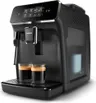 Philips Series 2200 EP2220/10 | 12 | not stated | Ceramic | not stated | not stated | £329.99 (RRP) | Check price on Amazon |
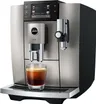 JURA E8 Piano Black (UKD) 15842 | 7 | not stated | not stated | not stated | not stated | £1,295 | Check price on Amazon |
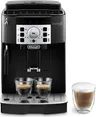 De'Longhi Magnifica S ECAM 22.110.B | not stated | not stated | not stated | not stated | £299.99 | £349.99 | Check price on Amazon |
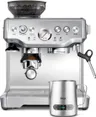 Sage the Barista Express (SES875) | 16 | Steel conical burrs | not stated | not stated | £499.00 | £629.95 | Check price on Amazon |
 De'Longhi La Specialista Arte Manual espresso maker EC9155.MB | 15 | not stated | not stated | not stated | £349.00 | £529.99 | Check price on Amazon |
 Ninja Luxe Café Premier (ES601UK) | 25 | not stated | not stated | not stated | £549.00 | £579.99 | Check price on Amazon |
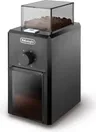 De'Longhi KG79 Electric Burr Coffee Grinder | 16 | Steel flat burrs | not stated | not stated | £40.00 | £66.99 | Check price on Amazon |
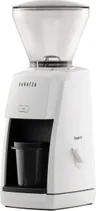 Baratza Encore ESP | not stated | Steel conical burrs | not stated | 40 mm | £159.95 | £159.95 | Check price on Amazon |
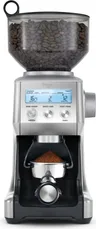 Sage the Smart Grinder Pro (SCG820) | 60 | Steel conical burrs | not stated | not stated | £179.99 | £209.95 | Check price on Amazon |
No model matches this selection.
Sources: manufacturer spec sheets and product pages. “not stated” means not stated by the manufacturer or not yet verified by us. Prices at Amazon: as of 10 Nov 2026, 10:31, checked once a day. They may have changed since; the price shown on Amazon at the time of purchase applies. Price stated by the manufacturer, excluding promotions. The retailer’s current price may differ. Photos: the respective manufacturers. Offer: Paid link. As an Amazon Associate I earn from qualifying purchases.
How to read it:
- Built into a bean-to-cup machine: from 7 settings on the JURA E8 to 12 on the Philips 2200. A bean-to-cup machine doses and brews by itself, so these scales are not directly comparable with those of espresso grinders.
- Built into an espresso machine: 15 on the De’Longhi La Specialista Arte, 16 on the Sage Barista Express, 25 on the Ninja Luxe Café Premier.
- Separate grinders: 16 on the De’Longhi KG79 against 60 on the Sage Smart Grinder Pro. Baratza does not state a number for the Encore ESP in the sources we read.
A caution on the KG79: De’Longhi says its fine position suits espresso machines. That is the maker’s statement, and it rests on the fine end of a 16-step scale. If you plan to use single wall baskets, weigh that against grinders whose makers give more steps. The grinder comparison sets them side by side, and the profiles of the Sage Smart Grinder Pro and the Baratza Encore ESP give the detail.
Ceramic or steel, flat or conical?
Here the data runs out quickly, and we would rather say so than fill the gap.
- Material. Philips describes the grinders of its 2200, 3300, 5400 and 5500 series as ceramic and, in its Series 2200 leaflet, claims a life of at least 20,000 cups for them (Philips Series 2200 Fully automatic espresso machines EP2220/14). Siemens also states ceramic for the EQ.6 plus s300. Sage and Baratza state steel. None of them publishes figures that would let you compare wear, heat or consistency between the two materials.
- Shape. Most grinders in our database with a stated shape are conical; the De’Longhi KG79 has flat steel burrs. Philips, De’Longhi and Siemens do not state the shape of the burrs in their bean-to-cup machines.
So we treat burr material and shape as descriptions, not as rankings. Measuring what actually comes out of a grinder is on the list in our method.
Before you blame the grinder
Three things the manuals mention that look like a grind problem and are not:
- Stale coffee. Sage recommends beans with a roasted-on date, used between 5 and 20 days after it, and says stale coffee may pour too quickly.
- Coated beans. De’Longhi warns against caramelised or candied beans, which can stick to the mill and damage it.
- Dose. On an espresso machine, too little coffee in the basket speeds up the flow just as a coarse grind does.
If you are still choosing rather than adjusting, the first espresso machine comparison shows which machines come with which baskets, and the terms used on this page are defined in the glossary. To see what a larger dose does to your budget, try the cost per cup calculator.
Frequently asked questions
When can I change the grind setting on a bean-to-cup machine?
Only while the grinder is running. De'Longhi's manuals say the dial must only be turned when the coffee mill is in operation, and Philips says the grinder settings can only be adjusted during grinding. Move one step at a time.
Why does the coffee not change straight after I adjust the grind?
Because coffee ground at the old setting is still in the system. De'Longhi says the effect only shows after at least two coffees. Philips says to brew two to three cups so that the grinder can adjust to the new setting.
Is a grinder with more settings better?
More settings mean smaller steps between one grind and the next, not a better grind in itself. Small steps matter most for espresso made in non-pressurised baskets, where a slight change in grind alters the flow. For filter coffee or a cafetière, a coarser scale is enough.
Are ceramic burrs better than steel burrs?
The manufacturers' data does not settle it. Philips and Siemens state ceramic for their bean-to-cup grinders; Sage and Baratza state steel conical burrs. None publishes comparable figures on grind consistency or heat, so we do not rank one material above the other.
My espresso runs too fast. Should I grind finer?
According to Sage's guide for the Bambino, espresso that starts flowing within the first six seconds points to too little coffee in the basket, a grind that is too coarse, or both. Change one of the two, not both at once, so you can see which made the difference.