The short answer
Before you compare features, check eight things: the space, the exact variant, the milk system, the drinks you really make, the grinder question, your water, the claims that mean nothing, and the running costs. Each takes a few minutes and each can be checked against published data. The sections below show how, using the manufacturer figures in our database. None of it relies on our own experience of the machines, which we do not have yet.
1. Not measuring the space
Width is the figure everyone looks at. Depth and height are the ones that catch people out.
A Philips 2200 is 24.6 cm wide, but 43.3 cm deep and 37.1 cm tall. The Siemens EQ.6 plus s300 is 46.5 cm deep. A De’Longhi Dedica EC685, an espresso machine, needs only 14.9 cm of width.
What to do:
- Measure width, depth and the height under any wall cupboard.
- Find out from the manual where the bean hopper and water tank are filled from, and where the service door for the brew unit opens. On the De’Longhi Magnifica S, for example, that door is on the right-hand side. A machine that fits when closed may not fit when you need to get into it.
- Check the cup clearance if you use tall mugs: the Magnifica S takes cups up to 14 cm.
The compact bean-to-cup comparison is sorted on verified width and depth for exactly this reason.
2. Buying the range name, not the variant
Model names cover several variants, and the difference between them is often the very thing you were buying for.
- Philips 2200. Our data describes the EP2220/10, which has a classic milk frother. In some markets Philips also sells 2200 variants with the LatteGo milk container. Same name, different milk system.
- De’Longhi Magnifica Evo. Depending on the model code, it comes with a LatteCrema milk carafe or with a manual frother. Our profile describes a carafe version.
- Philips 3300. There are LatteGo versions and versions with a classic frother.
What to do: before you pay, read the full model code on the retailer’s page (the letters and digits after the range name) and compare it with the one on the manufacturer’s page. Our Philips range guide and De’Longhi Magnifica range guide list which code has what.
3. Assuming “it does milk” means one thing
There are several kinds of milk system in our tables, and they ask different things of you:
Table scrolls sideways →
| Model | Milk container | Offer | |||||
|---|---|---|---|---|---|---|---|
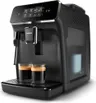 Philips Series 2200 EP2220/10 | Steam wand | not stated | 2 | Mid-range | not stated | £329.99 (RRP) | Check price on Amazon |
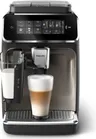 Philips Series 3300 LatteGo EP3347/90 | LatteGo | 0.26 l | 5 | Mid-range | £420.86 | £569.99 | Check price on Amazon |
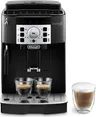 De'Longhi Magnifica S ECAM 22.110.B | Steam wand | not stated | 2 | Mid-range | £299.99 | £349.99 | Check price on Amazon |
 De'Longhi Magnifica Evo ECAM 290.83.TB | Milk carafe | not stated | 7 | Upper mid-range | not stated | £579.99 | Check price on Amazon |
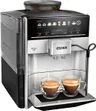 Siemens EQ6 plus s300 TE653M11GB | Milk hose | not stated | 11 | Upper mid-range | not stated | not stated | Check price on Amazon |
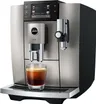 JURA E8 Piano Black (UKD) 15842 | Milk hose | not stated | 27 | Premium | not stated | £1,295 | Check price on Amazon |
No model matches this selection.
Sources: manufacturer spec sheets and product pages. “not stated” means not stated by the manufacturer or not yet verified by us. Prices at Amazon: as of 10 Nov 2026, 10:31, checked once a day. They may have changed since; the price shown on Amazon at the time of purchase applies. Price stated by the manufacturer, excluding promotions. The retailer’s current price may differ. Photos: the respective manufacturers. Offer: Paid link. As an Amazon Associate I earn from qualifying purchases.
- A steam wand or manual frother means you froth the milk yourself in a jug.
- A carafe or milk container delivers the milk drink at the press of a button, and has to be cleaned afterwards. The LatteGo container holds 0.26 l.
- A milk hose draws from a carton or a separate container, which may not be included.
If you make cappuccinos daily, this choice shapes your routine more than anything else. See bean-to-cup machines with a milk system, and the cleaning guide for what each system needs after use.
4. Counting drinks
The “drinks” column in the table above is the number each manufacturer announces. It runs from 2 on the Philips 2200 to 27 on the JURA E8, and the counts are not made the same way: some makers include hot water, steam or a portion of milk froth, and some count variations of the same drink.
What to do: write down the two or three drinks your household actually makes. Then check that each has its own button or menu entry on the model you are considering. A long list you never scroll through is not worth a higher price band.
5. Forgetting the grinder with an espresso machine
A bean-to-cup machine has a grinder by definition. Most espresso machines do not. The data marks the exceptions, such as the Sage Barista Express, as having an integrated grinder.
Without a grinder you are limited to pre-ground coffee. Sage’s guide for the Bambino explains what that means for its baskets: dual wall baskets are intended for pre-ground coffee and older beans, single wall baskets for freshly ground beans (the Bambino BES450/SES450 EN Quick Guide). To use the machine as its maker intends with fresh beans, you need a grinder that adjusts in small steps.
What to do: treat machine and grinder as one purchase. Our budget espresso and grinder pairings add the two together by price band, and the grind guide explains why the grinder matters.
6. Ignoring your water
Scale is the main maintenance issue for any machine that heats water, and how much of it you get depends on your postcode. The Drinking Water Inspectorate notes that hard water causes scaling in domestic appliances and shortens their life (Water Hardness / Hard Water).
What to do: look up your hardness with your water company before you buy, set the machine’s hardness level on day one, and decide whether you will use the maker’s filter. The water hardness guide has the bands and the conversion to Clark degrees.
7. Being impressed by figures that separate nothing
Two examples from our own tables:
- Pump pressure. Every machine in our UK tables whose maker publishes a pump pressure states 15 bar. That goes for the De’Longhi Stilosa in the entry-level price band and for the JURA E8 in the premium one. A figure that is the same everywhere cannot be a reason to choose.
- Quietness. No manufacturer in our database publishes a noise level in decibels. Philips, for instance, uses the name SilentBrew on some series without giving a figure. Until someone measures it under the same conditions, “quiet” is a description, not data. Noise is on our own measurement list, as the method page explains.
What to do: give your attention to the figures that do differ between models, such as dimensions, tank and hopper capacity, milk system and number of grind settings.
8. Looking at the purchase price only
The price on the day is one part of what a machine costs you. The rest arrives later:
- Coffee, which depends on your dose and on beans against pods.
- Consumables: filters, descaler, cleaning tablets on brands that require them.
- The machine’s share of each cup, which shrinks the more cups you make.
A machine in a higher price band can cost less per cup than a cheaper one if it is used several times a day for years. The sums are in what a cup of coffee really costs, and the cost per cup calculator runs them with your prices. We show price bands and, where available, the Amazon price, with the date and time we checked it, plus the manufacturer’s RRP where the manufacturer publishes one. The Amazon price is checked once a day and may have changed since; the price that counts is the one Amazon shows when you buy.
A two-minute checklist
- Space measured: width, depth, height, access.
- Exact model code checked against the manufacturer’s page.
- Milk system chosen on purpose.
- Your own two or three drinks present.
- Grinder budgeted, if it is an espresso machine.
- Water hardness known.
- Shared figures ignored, real differences compared.
- Running costs estimated.
If you would like the first five handled for you, the machine finder below asks about them one by one and suggests models from our database. And if you have not yet settled on a type of machine, start with bean-to-cup, pods or espresso machine.
Frequently asked questions
What is the most common mistake when buying a bean-to-cup machine?
Not measuring. The bean-to-cup machines in our UK tables are 35 to 39 cm tall and 43 to 47 cm deep, and that is before you allow room to fill the bean hopper or open a service door. Measure the space, including the height under any wall cupboard, before comparing anything else.
Does a higher pump pressure make better espresso?
The figure does not help you choose. Every machine in our UK tables whose maker publishes a pump pressure states the same 15 bar, from entry-level espresso machines to premium bean-to-cup models. A number shared by everything separates nothing.
Can I compare machines by the number of drinks they make?
Only loosely. The number is the one each manufacturer announces, and they do not count alike: some include hot water, steam or milk froth as drinks. Look at which drinks are on the list, and whether the ones you actually make have their own button.
Which coffee machine is the quietest?
Nobody can tell you from published data. None of the manufacturers in our database publishes a noise level in decibels for these machines. Names such as SilentBrew come without a figure. Noise is one of the measurements we plan to make ourselves.
Do I need a grinder with an espresso machine?
If the machine has no built-in grinder and you want to use whole beans, yes. Budget for it from the start. The alternative is pre-ground coffee in pressurised baskets, or ESE pods on machines that accept them.