The short answer
- You want coffee at the press of a button, several times a day, from whole beans: a bean-to-cup machine.
- You drink one or two cups a day and want the least possible fuss: a pod machine does the job, at a higher cost per cup.
- You want to control the result and enjoy the process: an espresso machine with a portafilter, plus a grinder.
That is the whole decision in three lines. The rest of this page gives you the figures and the reasoning to check it against your own kitchen and habits. One limit to state straight away: kaffeemetrik lists bean-to-cup machines, espresso machines and grinders. We do not list pod machines, so pods are covered here as a system, without model data.
What you actually do for each cup
| Pod machine | Bean-to-cup | Espresso machine | |
|---|---|---|---|
| Coffee goes in as | a sealed pod | whole beans in a hopper | ground coffee in a basket |
| Grinding | done at the factory | done by the machine | done by you, in a separate or built-in grinder |
| Your part | insert pod, press | press | grind, dose, tamp, lock in, start, stop |
| Left over | a used pod | a puck in the grounds container | a puck to knock out |
| Milk drinks | depends on the machine | steam wand, carafe or hose, depending on the model | steam wand, manual or automatic |
The right-hand column is longer because the work is yours. Sage’s guide for the Bambino describes it: grind enough coffee to fill the basket, tamp firmly and consistently, then judge the shot by how the espresso flows (the Bambino BES450/SES450 EN Quick Guide). Some people buy an espresso machine precisely for that. Others discover they wanted a button.
Five machines, three ways of working
To make the comparison concrete, here are two bean-to-cup machines and three espresso machines from our database, one of them with a grinder built in. The figures come from the manufacturers.
Table scrolls sideways →
| Model | Built-in grinder | Offer | ||||||
|---|---|---|---|---|---|---|---|---|
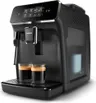 Philips Series 2200 EP2220/10 | 24.6 × 37.1 × 43.3 cm | 1.8 l | Steam wand | not stated | Mid-range | not stated | £329.99 (RRP) | Check price on Amazon |
 De'Longhi Magnifica Evo ECAM 290.83.TB | 24 × 36 × 44 cm | 1.8 l | Milk carafe | not stated | Upper mid-range | not stated | £579.99 | Check price on Amazon |
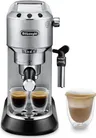 De'Longhi Pump Espresso Coffee Machine Dedica EC685.M | 14.9 × 30.5 × 33 cm | 1.1 l | Steam wand | not stated | Entry level | £149.00 | £229.99 | Check price on Amazon |
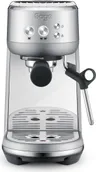 Sage the Bambino (SES450) | not stated | 1.4 l | Steam wand | not stated | Mid-range | not stated | £329.95 | Check price on Amazon |
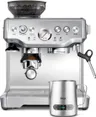 Sage the Barista Express (SES875) | 31.8 × 40.4 × 35.1 cm | 2 l | Steam wand | Yes | Upper mid-range | £499.00 | £629.95 | Check price on Amazon |
No model matches this selection.
Sources: manufacturer spec sheets and product pages. “not stated” means not stated by the manufacturer or not yet verified by us. Prices at Amazon: as of 10 Nov 2026, 10:31, checked once a day. They may have changed since; the price shown on Amazon at the time of purchase applies. Price stated by the manufacturer, excluding promotions. The retailer’s current price may differ. Photos: the respective manufacturers. Offer: Paid link. As an Amazon Associate I earn from qualifying purchases.
A few things stand out:
- Space. The Dedica EC685 is 14.9 cm wide. A Philips 2200 is 24.6 cm wide and 43.3 cm deep. But the Dedica has no grinder, so add the footprint of one if you want to use beans.
- Grinder. A bean-to-cup machine always has one. Among espresso machines it is the exception: the Sage Barista Express has a built-in grinder with 16 settings, and takes up 31.8 cm of worktop as a result.
- Price band. The cheapest espresso machines sit in a lower band than the cheapest bean-to-cup machines, but the comparison is only fair once a grinder is counted. The budget espresso and grinder pairings do that sum.
Running costs: where pods lose and when it matters
The structure is the same whatever the prices:
- Pods: the coffee cost per cup is the price of one pod. A pod machine typically costs less to buy than a bean-to-cup machine.
- Beans: the coffee cost per cup is the price per kilo divided by 1,000, times the grams used. The machine costs more.
So pods cost more per cup and less up front, and the two lines cross at some number of cups. At one cup a day that crossing point can be years away; at four cups a day in a two-coffee household it comes much sooner. We explain the arithmetic in what a cup of coffee really costs, and the calculator runs it with your own prices:
ToolCost per cup calculator: beans or pods?One point on dose, because it changes the result: an espresso machine can use much more coffee per drink than you might expect. Sage designs the Bambino’s baskets for 8 to 11 g in the one-cup basket and 16 to 19 g in the two-cup basket. If your daily drink is a double, count it as one.
Upkeep: three different lists
- Pod machine: the shortest list, with no grinder and no loose grounds to deal with; rinsing and descaling follow the maker’s instructions. The price of that convenience is the waste stream. In the UK, aluminium and plastic pods can be returned through Podback, a not-for-profit scheme created by Nestlé and Jacobs Douwe Egberts and funded by its member brands. It is free to use and lists more than 1,500 drop-off points (Coffee pod recycling made easy).
- Bean-to-cup: the longest list. Drip tray and grounds container, brew unit weekly or monthly depending on the brand, milk system after every use, descaling when the machine asks. Our cleaning guide sets out what Philips and De’Longhi require.
- Espresso machine: rinse the basket and portafilter, wipe and purge the steam wand, empty the drip tray, descale when prompted. Shorter, but it happens at every single shot.
All three need descaling if your water is hard. That depends on your postcode more than on the system: see the water hardness guide.
The middle ways
The three categories blur at the edges, and that is useful:
- Espresso machine with ESE pods. Some entry-level machines take ESE paper pods as well as ground coffee. Their makers list the De’Longhi Dedica EC685, the De’Longhi Stilosa EC260 and the Krups Virtuoso as compatible. You get pod-like convenience on weekdays and a portafilter at the weekend.
- Espresso machine with pre-ground coffee. Sage supplies the Bambino with dual wall baskets, which it says are for pre-ground coffee and older beans, as well as single wall baskets for freshly ground beans. You can start without a grinder and add one later.
- Espresso machine with a built-in grinder. One appliance instead of two, with the grinding still under your control: the Sage Barista Express or the Ninja Luxe Café Premier, compared head to head here.
Which way to go, by situation
- If you make more than three or four cups a day between you, then the per-cup saving of beans adds up fast: look at bean-to-cup machines, starting with the affordable ones.
- If most of your drinks are cappuccinos or lattes, then the milk system matters more than the category: see bean-to-cup machines with a milk system, or an espresso machine with an automatic wand.
- If your worktop is narrow, then check widths before anything else: the compact bean-to-cup comparison is sorted on verified dimensions.
- If you want to learn espresso, then start with a first espresso machine and budget for a grinder from the grinder comparison.
- If you are still unsure, the machine finder asks the same questions in order.
What this page cannot tell you
Which system makes the coffee you will prefer. Taste depends on the beans, the water and your own palate, and we have not brewed with any of these machines. What the data can do is rule out the options that do not fit your space, your routine or your price band, which is usually most of them.
Frequently asked questions
Is a bean-to-cup machine cheaper to run than a pod machine?
Per cup of coffee, whole beans usually cost less than pods, but the machine costs more to buy. Whether you come out ahead depends on how many cups you make a day and how long you keep the machine. Our cost per cup calculator works it out from your own prices.
Do I need a separate grinder with an espresso machine?
Unless the machine has a built-in grinder, yes, if you want to use whole beans. Sage, for example, says its single wall baskets are for freshly ground beans and its dual wall baskets for pre-ground coffee. Some entry-level machines also accept ESE paper pods, which need no grinder.
Are ESE pods the same as coffee pods?
No. In the UK, pods usually means sealed aluminium or plastic capsules made for one brand's machines. ESE pods are flat paper pods of ground coffee that fit certain espresso machines with a portafilter. In our database, the De'Longhi Dedica EC685, the De'Longhi Stilosa EC260 and the Krups Virtuoso are listed by their makers as ESE compatible.
Which system takes up the least space?
Among the machines we list, the narrowest are espresso machines: the De'Longhi Dedica EC685 is 14.9 cm wide. The bean-to-cup machines in our UK tables are between 24 and 28 cm wide and need more depth. Remember that an espresso machine may also need room for a grinder.
Can used coffee pods be recycled in the UK?
Yes, through Podback, a not-for-profit scheme funded by pod brands. It takes aluminium and plastic pods free of charge at drop-off points, and through some council services. Check what is available at your postcode on the Podback website.